The Evidence
Drought and a shrinking U.S. flock are shaping America's lamb supply. Here is what the public record shows, from the ITC's docket and official U.S. government data, with a source for every number.
The drought behind the price story
Over the five years under investigation, American ranchers endured one of the worst droughts in living memory.
Economic analysis filed with the Commission by Georgetown's Rodney Ludema and Rutgers' Thomas Prusa finds drought accounts for 73.1% of the movement in U.S. wholesale lamb prices that their model explains; imports, less than 2%.1
All of California was in drought from mid-May through December 2021.2 On December 7, 2021, drought covered 94.6% of the 11 western states, a record in the U.S. Drought Monitor's history for the region.3
Drought hit cattle too. USDA economists tied heavy cow culling in 2022 to drought.4 In January 2026, the U.S. beef cow herd was the smallest since 1961.5
Yet in the 395-page public staff report prepared for the Commission, the word "drought" appears once.6
A flock that has been shrinking for decades
For every eight sheep in America's flock 50 years ago, three remain: 13.3 million head in January 1976, 4.99 million in January 2026.7,8
The decline continued through the years the Commission is examining. The flock fell by 145,000 head between January 2021 and January 2025.6
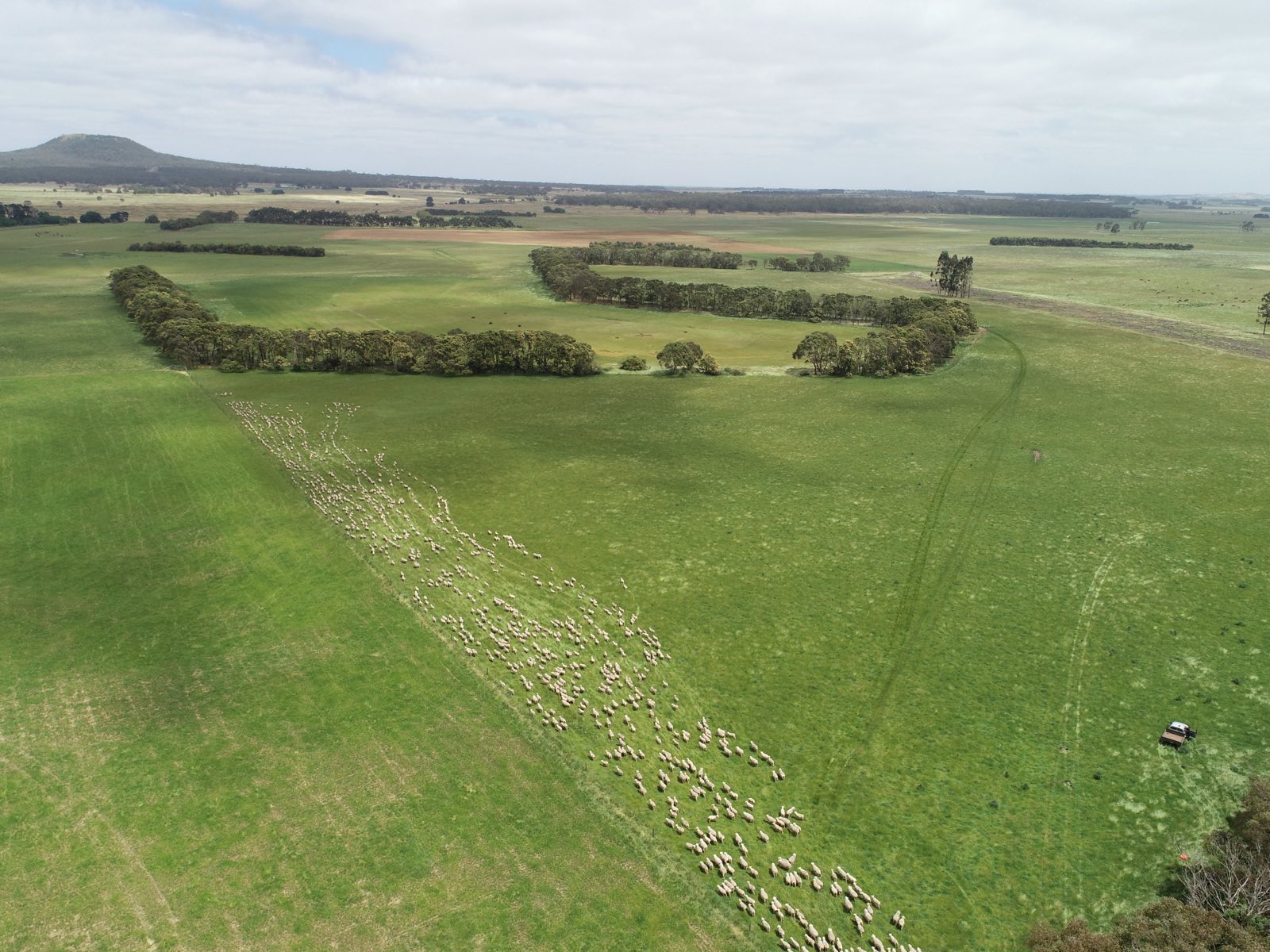
Whether you're a rancher in the United States or a grazier in Australia, rearing sheep is a hard business, and particularly when drought hits.
No surge in imports
Total lamb imports rose 14.7% from 2021 to 2025, according to official import statistics.9
That is about 3.5% a year, slower than the 4.4% a year from 2010 to 2020.10
Australian lamb exports to the United States were 12.1% lower in January to September 2026 than a year earlier.9
In each month since the investigation period ended, official Australian export data show lamb exports to the United States 37.8% to 53.6% lower by volume than a year earlier, according to the brief of Meat & Livestock Australia and Thomas Foods International USA.9
From 2021 to 2025, Australian lamb exports to the United States grew 7% by volume, while Australia's lamb exports to all markets grew 37%.6
Imports fill the gap
Imported lamb is counter-seasonal, it complements domestic production, helping keep lamb on shelves and menus year-round.
Different products for different buyers
Most U.S. producers (7 of 10), importers (13 of 15) and purchasers (8 of 13) told the Commission U.S. and imported lamb are only sometimes or never interchangeable.6
Most imported lamb is shipped frozen (51.4% of importers' U.S. shipments by volume in 2025), while large U.S. producers ship more than 80% of their lamb fresh or chilled.6
U.S. producers received more per pound for their lamb: the average unit value of their U.S. shipments rose from $5.95 a pound (in U.S. dollars) in 2021 to $6.79 in 2025, and from $6.97 in the first half of 2025 to $9.33 in the first half of 2026.6,9
Steady supply, stronger processors
The prehearing brief of Meat & Livestock Australia and Thomas Foods International USA, drawing on Commission questionnaire data, finds processors that use at least some imported lamb were consistently more profitable than those relying only on U.S. lamb, because steady supply kept labor and other factory costs down as a share of their costs, not because imported lamb was cheaper.9
What U.S. producers told the Commission
Protect supply. Grow demand.
Drought and other factors mean any restrictions on imported lamb would see Americans eat less lamb overall, because it would be harder to source, more expensive and less competitive than other proteins.
We look forward to working with U.S. industry, the ITC, and the administration toward an outcome that protects supply, builds demand and grows appetite for lamb.
What we heard on October 16
At the ITC's public injury hearing, U.S. lamb processors and economists who have studied the market told the Commission what drought and a shrinking flock mean for America's lamb supply. In their words:
“Drought also causes producers to cull mature breeding ewes. This reduction in the breeding flock contracts the U.S. lamb crop, depressing slaughter counts and elevating wholesale prices well into the future.”11
“The bottom line: lack of rain has been a major challenge for domestic lamb farmers and lamb meat producers during the period.”12
“U.S. processors of only American lambs cannot meet the necessary specifications and year-round consistency because the U.S. flock is limited seasonally and by the number of animals available to process.”11
“When we cannot get enough American lamb, we choose to purchase more imported lamb, which is counter-seasonal and available year-round, particularly in the summer.”11
“American lamb is a distinctively different product. It's a premium lamb considered the best in the world, and we market it that way.”12
“The record shows that U.S. producers who process at least some imported lamb had consistently higher profitability than those that rely on domestic lamb exclusively. This stronger performance is not because the cost of imported lamb was lower, but rather because it provided more stable supply, which resulted in other production costs being lower.”11
“… growing the market is critical for the domestic lamb meat producers to thrive. This means getting lamb more regularly into the American diet and that requires getting multiple cuts available in all supermarkets across the country.”11
Quotes are exact; an ellipsis marks words left out. Written testimony is on the ITC's public docket. Quotes marked “at the hearing” are from an unofficial transcript, not the official ITC record.
Sources
- Rodney Ludema and Thomas J. Prusa, "An Economic Analysis of Imported Lamb on U.S. Lamb Prices and Sales," October 8, 2026, Appendix A to the prehearing injury brief of Meat & Livestock Australia and Thomas Foods International USA, PDF p. 93 [report p. 86], Table 6. EDIS doc. 897870.
- U.S. Drought Monitor, California drought statistics, 2021 weekly maps (share of the state in drought, categories D1–D4).
- NOAA National Centers for Environmental Information, Drought: Annual 2021 report, West section.
- USDA Economic Research Service, Livestock, Dairy, and Poultry Outlook: February 2023 (LDP-M-344), p. 3. USDA (PDF).
- USDA Economic Research Service, Livestock, Dairy, and Poultry Outlook: February 2026 (LDP-M-380), p. 2. USDA (PDF).
- ITC, Lamb Meat, Inv. No. TA-201-80, prehearing staff report (public version), October 2, 2026, PDF pages, with report pages in brackets: the single use of "drought," p. 42 [1.30]; flock, p. 82 [Table 3.1]; Australian exports, p. 186 [4.26]; import share and consumption, pp. 18 [1.6] and 283 [Table C.1]; interchangeability, p. 245 [Table 5.21]; frozen imports, p. 62 [Table 2.3]; U.S. producers' fresh and chilled shipments, p. 111 [3.31]; U.S. producers' shipment unit values, p. 285 [Table C.1, C.5]. EDIS doc. 896447.
- U.S. Department of Agriculture (USDA), Sheep and Goats, January 28, 1976, p. 1. USDA (PDF).
- USDA National Agricultural Statistics Service, Sheep and Goats, January 2026, p. 1. USDA (PDF).
- Meat & Livestock Australia and Thomas Foods International USA, prehearing injury brief (public version), October 9, 2026, PDF pages, with brief pages in brackets: imports 2021–2025, p. 32 [21]; U.S. producers' shipment unit values, p. 102 [91]; monthly Australian exports after the investigation period, p. 117 [106]; Australian exports in 2026, p. 118 [107]; processor profitability, pp. 65–69 [54–58]; U.S. producers' questionnaire answers, p. 12 [1]. EDIS doc. 897870.
- Government of Australia, prehearing submission, October 8, 2026, p. 8. EDIS doc. 897067.
- Meat & Livestock Australia and Thomas Foods International USA, hearing testimony and presentation, filed October 15, 2026, PDF pages, with statement pages in brackets: Anthony Catelli Jr., p. 9 [3]; Michael Forrest, p. 12 [2]; James Dougan, p. 19 [3]; Thomas J. Prusa, p. 25 [2]; Rodney D. Ludema, p. 29 [3]. EDIS doc. 897894.
- Testimony at the ITC's public injury hearing, Lamb Meat (Injury), October 16, 2026, afternoon session, in passages labeled 15:05:46 ET (Thomas J. Prusa) and 15:42:46 ET (Anthony Catelli Jr.). Quoted from an unofficial transcript, not the official ITC record. ITC hearing page.
Documents marked EDIS are on the ITC's public docket. Opening them requires a free EDIS account, which you can create with Login.gov.